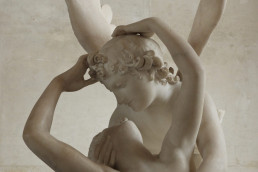
Mária Szepes (1908–2007) was an influential Hungarian author, screenwriter, and esoteric philosopher renowned for her spiritual literature and hermetic teachings. Born into a theatrical Budapest family, she began her career in journalism and screenwriting before dedicating her life to mystical philosophy.
In 1930 (or early 1931) she married Béla Szepes, an Olympic silver medalist in javelin throw, a ski champion, and a notable graphic artist and 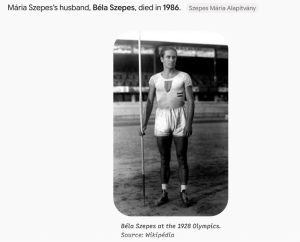 journalist. They were together until his death.
An apparent impetus for Mária’s spiritual work was the loss of their only child after seven years of marriage. He died at just seven months. The loss deeply shaped Mária’s spiritual outlook. She came to view her son as a brief “traveller” in their lives. The couple never had children, remaining devoted to one another and their creative work throughout their 56-year marriage.
Throughout her life, Mária authored dozens of books on mysticism, poetry, and philosophy. Today, she remains celebrated as one of Central Europe’s foremost modern esoteric authors and spiritual guides.
Her powerful masterpiece, The Red Lion (A Vörös Oroszlán, 1946), explores alchemy, reincarnation, and spiritual evolution across centuries. Published under a pseudonym, it was quickly banned and ordered destroyed by the communist regime, forcing Mária to circulate her esoteric writings underground for decades.
The Szepes were “synergy explorers”
Mária Szepes’s brief non-fiction work The Magic of Love (A szerelem mágiája,1990) makes it clear that she and her spouse Béla were exploring the synergy between lovers who cultivate their sexual energy for a spiritual end. Unfortunately the work is only available in Hungarian.
It explores the Alchemical Wedding or Unio Mystica. In it Mária distinguishes two possible outcomes of sexual union:
The first is a “vortex that begets death” — the ordinary, ego-driven, orgasm-oriented act, which she repeatedly calls a “horrible parody” of the mystic union. She compares it to the devouring of the male by the female mantis or black widow spider.
Szepes contrasts such conventional sex with what she calls the Unio Mystica or Alchemical Wedding — an ecstatic three-plane fusion (physical, astral, mental) in which time dissolves. She elaborates that “maximum creative potency is identical with total stillness in the eternal present”, explaining that this phenomenon is the real goal of love.
In one striking passage she describes two people who, “without any eroticism, locked as one in the crystal of side-by-side presence”, suddenly realise that this is not the opposite of pleasure but fullness itself. That is, the experience the blissful peace of wholeness and the absence of aching longing. Yet at the same time the “wedding of the two” on every plane is the erupting ecstasy of the creator, i.e., glorious aliveness within the living being.
Tips
Mária invites readers on a “magical excursion” — not to a place but to a state, in which love never becomes boring. She argues that this luminous state is real and lies within us. Anyone can create it with a little unselfishness, wisdom, and great love.
 She offers the book as fruit of her own 56-year marriage to Béla Szepes, who, she says, remained present within her even after his death. She recalls their marriage without a single quarrel across half a century, and dedicates the method to readers willing to accept it.
Her core injunctions: Choose each other with more than the senses. Psychic and spiritual fit is as essential as sexual attraction. Love each other without possession and without stifling demands. And put “You” before “I”.
Only matched partners can attain this transformative wholeness. Lovers are compatible when their +/– polarities across the three planes complete each other into a whole — a functional androgyne formed by the couple.
She warns that intense attraction is usually a projection of one’s own momentary lack, not an ideal meeting. The right lover is not a mere physical/emotional partner but the abstract other half of one’s own being. As explained, that union takes place on the spiritual plane.
In contrast, the familiar physical passion often separates the halves rather than joining them. Unifying them requires dismantling the sensual/emotional constructions that seem to bind lovers together.
According to Szepes, physical begetting is the lowest and most mortality-bound use of sexual energy. That same energy, when redirected upward, produces art, spiritual awakening, and the “Alchemical Wedding” of the two into one.
A “bad” marriage can still be a salvation-marriage if its sexual fire is a refining hell. In contrast, a “good” marriage is a rare oasis whose warmth is steady rather than blazing.
She also shares much practical marriage advice, including “What we must never do” and “What we must never fail to do”.
Sex good, discharge not
Mária clearly advised non-orgasmic union. She framed romantic and interpersonal love as a transformative force essential for inner alchemy (i.e., restoring awareness of our innate androgyny). And essential as well for expansion of consciousness, and personal self-realisation.
While she characterises conventional sex as draining (or worse), she also criticises sexual abstinence. In her view, repressed sexual energy in celibates ferments and explodes into fanaticism or violence. She explicitly rebukes dogmatic Christian clergy for imposing sexual restrictions that cause “unnecessary spiritual anguish”.
So her position is not “don’t have sex”. Rather it is closer to “let sexual energy flow, but recognise that its highest realisation is on the spiritual plane, not in discharge”.
In her view, sexual love is the most animal, most demonic, and most divine region of the personality. Szepes argues that Freud (sexual drive), Adler (power drive), and Jung (thirst for God, individuation) each grasped but one true face of the same underlying creative energy operating on three different planes — physical, psychic, and spiritual.
Sexual energy is creative potency in eruption — if it cannot build, it destroys, so it must be directed. She cites the Bhagavad Gītā on the impossibility of inaction.
Primordial androgyny
In Mária’s view, every organism arises from the interplay of masculine and feminine energies. Images of the androgyne, in her formulation, symbolise “a sexual exchange taking place in a different dimension of time.”
Together, lovers in this dimension can fall into a state where they can experience their androgynous reality beyond time and space. However, in our physical dimension the merging is energetic. Actual merging of bodies (beyond sexual union) doesn’t occur.
Today’s physically dense human may claim androgyny, but does not fully experience themselves as whole. Instead we individually remain “gnawed in the no-man’s-land of hopeless passions.”
Unconsciously we remember what we were, and long for what we will become again. In fact, we are longing for what we still are beyond the material plane to which our senses are generally limited.
That is, we (together) remain androgynous in another phase of existence. On the familiar material plane, however, each individual is typically left with an “eternal ache” caused by the shattering of that essential unity.
The experience of the Unio Mystica or Alchemical Wedding permits lovers to perceive and integrate the truth of their larger circumstances. It calls for sex without orgasm. And if the lovers are correctly mated, they can experience their androgyny and divine origins. They are no longer deceived by their surface appearances on this plane.
Through the upward redirection of their creative energy, the lovers pass beyond the split-into-sexes. Then, “beyond every transient limit, is torn-apart God made whole again.”
Finally,
Here is the epigraph from The Magic of Love:
Within you lives the aching negative of your partner.
You wait for them to speak the magic words:
“I am You” — which will heal your eternal wound.
~ Mária Szepes
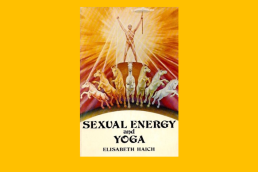
Mária was a peer and close friend of sacred sex/yoga teacher Elizabeth Haich, who was also Hungarian. See Sexual Energy and Yoga by Elizabeth Haich.