
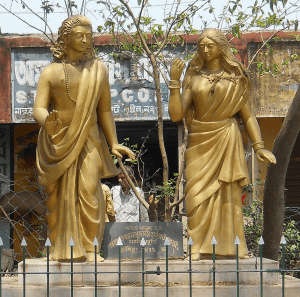
 Vaiṣṇava Sahajiyā was a form of Hindu tantric Vaishnavism (a major Hindu tradition), which developed in Eastern India. Adherents worshipped the divine lovers Radha and Krishna. This tradition flourished from the 16th to the 19th century. Oral tradition has it that this sect originated from the last surviving followers of Vajrayana (Buddhist sexual tantra).
Vaiṣṇava Sahajiyā used the romance between Krishna and Radha as a metaphor for union with the innate or primordial condition (the Sahaja) present in everyone. They sought to experience that union through its physical re-enactment in tantric ritual. To this end, they often made use of sexual intercourse in their tantric sadhanas. Vaiṣṇava Sahajiyās understood Krishna as being the inner cosmic form (svarupa) of every man and likewise Radha was seen as the inner form of women.
The Vaiṣṇava Sahajiyā tradition’s influences still appear in some modern Bengal Hindu tantrikas who claim to be Sahajiyās.
Vaiṣṇava Sahajiyās held that sexual yoga re-enacted the divine love between Radha and Krishna and allowed them to taste the flavor (rasa) of the divine love through their own personal experience. This is possible because all men and women are incarnations of God. Sexual sadhana was said to transform desire (kama) into pure divine love (prema).
Since the human body was connected with the larger universe in a divine manner, one could control the bodies energies (including sexual energies). Through this one could access divine cosmic forces and attain the highest reality.
The whole process of sexual yoga was held to be difficult. It required years of preparatory practices which included meditation, breathing exercises, and chanting, all of which culminated in the practice of tantric sex (sambhoga). In this sexual rite, the man was not supposed to ejaculate.
Through the practice of sambhoga, it was held that the couple could “return to the unity of the together-born state of sahaja – the absolute state prior to and beyond creation.”
The Vaiṣṇava Sahajiyā tradition included numerous female gurus, in contrast to many other Hindu tantric traditions. They also held that liberation could not be achieved without cooperating with a member of the opposite sex. [Emphasis supplied]
The Vaiṣṇava Sahajiyā tradition produced many great poets who wrote in the Bengali language, the most famous of these poets all wrote under the pen name Chandidas (a name used by various authors).
The Sahajiyās also made use of classic bhakti practices such as kirtan and chanting the names of Krishna as a way to intensify their feelings of love and devotion for Krishna.
Vaiṣṇava Sahajiyās believed that Gaudiya Vaiṣṇava masters like Chaitanya and Jayadeva had practised sexual sahaja sadhana. They also believed that the Buddha himself had practised this tantric method with his consort Gopa.
Vaiṣṇava Sahajiyās believed that human beings were a microcosm of the whole universe. As such, men and women are personifications of the supreme being (Brahman). As such as our divinity is naturally innate (the literal meaning of ‘sahaja‘). For the Vaiṣṇava Sahajiyās, the greatest quality of this natural divinity is pure love (prema) and their religion focused on awakening and supporting this innate divine love.
According to the Vaiṣṇava Sahajiyā text entitled Ratnasara:
All lives are created as a result of the union of the male and female elements, and so are human beings also. Under a favourable opportunity, God comes in the human body with all His natural characteristics, and the new form is nothing but a modified image of God…However transformed man may be by virtue of his birth, the divine element in him cannot remain concealed, and those who manifest this divine character to its fullest extent are called…by the term Sahaja.
Vaiṣṇava Sahajiyā practices also often involved breaking social norms, including those relating to caste. Because of their antinomian and erotic methods (which were viewed with suspicion by many), the Vaiṣṇava Sahajiyās operated in secrecy. In their literature they adopted a cryptic tantric language known as “intentional language” (Sanskrit: saṃdhyā-bhāṣā). For example, semen could be referred to with the term “rasa” (which can mean juice, like sugarcane juice).
Poem-songs (padavalis) were very important to the Vaiṣṇava Sahajiyā tradition. Most of these poems deal with devotion, yoga, meditation, mystical experience and divine love. These poems would often be sung to music.
The Necklace of Immortality is a key work of Mukundadeva or Mukundadasa. Written in the 17 century, it describes how the body is transformed through sexual sadhana:
27) A Divine Body (devadeha) must be born within the physical body. So how many men and women come to know that they possess a Divine Body?
28) With effort, you will discover the Divine Body within the physical body…
29) By performing ritual practices with a woman, the Divine Body will be discovered within the physical body. A woman who has realised her divine inner nature should server as the passionate Female Partner.
34) The blessed Inner Damsel Body leads the adept to the Vraja heaven. With her body of eternity, she helps the adept to master the passions.
35) Without her, you’ll never taste the passion-filled Cosmic Substances of the Vraja heaven. For adepts seeking Vraja, she is the very essence of the way of passion.
37) The Female Partner who is imbued with Divine Love shimmers with erotic energies, and is herself a well of Divine Essence. …She is the well of both Divine Essence and Cosmic Substance.